

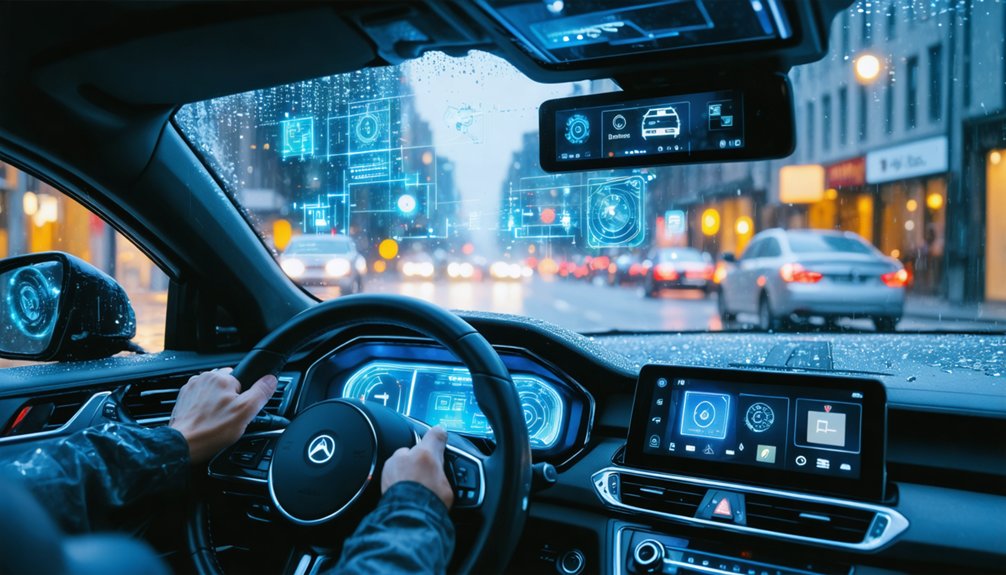
Connected vehicles supply continuous telematics, crash and safety feeds that let insurers price risk more granularly, adjusting premiums in real time. Over 21 million U.S. policyholders shared telematics in 2024 and market forecasts predict growth. Automated crash data speeds FNOL, reduces fraud and lowers investigation costs. Underwriting shifts toward software, cyber and OEM liability as autonomy rises. Privacy, consent and location‑data risks require new governance. Further sections explain how these impacts affect drivers and carriers.
What “Connected Vehicles” Mean for Auto Insurance
Data-rich vehicles are reshaping auto insurance. Industry forecasts indicate that 90% connected of new US vehicle sales will be connected by 2025. Connected vehicles—projected to comprise 90% of new US sales by 2025 and nearly 367 million units worldwide by 2027—redefine risk pools, liability, and product design for insurers. Growth of a $74.39 billion market in 2024 to $165.53 billion by 2029 pressures carriers to adapt to mixed fleets, including EVs and fleet electrification initiatives. Meanwhile, the usage-based insurance market is expanding rapidly, projected to grow to USD 80.7 billion by 2028, driving demand for telematics. Liability shifts toward OEMs and software vendors necessitate hybrid personal/product policies and higher commercial limits for AV testing. In higher automation levels, liability increasingly falls to manufacturers and software providers, reflecting a manufacturer liability trend. Regional responses—California’s $5 million testing mandate, Arizona’s commercial emphasis, Texas’s truck adaptations—signal regulatory harmonization as essential for scalable products. Insurers and automakers forming partnerships to bundle coverage reflect a market moving from uniform policies toward modular, situation-aware solutions. Stakeholders seek inclusive governance and consistent data standards nationwide.
How Telematics Data Changes Underwriting and Premiums
By 2024, 21 million U.S. policyholders were sharing telematics data and adoption has grown at a 28% CAGR since 2018, supporting a telematics insurance market valued at USD 3,542.1 million in 2025 and projected to reach USD 19,339.7 million by 2035. However, overall UBI market penetration remained low, estimated at around 5% in 2021. Industry adoption is significant, with 21+ million U.S. policyholders sharing telematics data with insurers in 2024.
Telematics reshapes underwriting by replacing static risk proxies with continuous behavioral inputs: speed profiles, harsh events and location patterns. The telematics insurance market was valued at USD 3,542.1 million in 2025. Predictive underwriting models ingest this telemetry to score risk in real-time, improving selection and reducing premium leakage.
Pricing shifts from demographic averages to personalized rates, enabling Usage based discounts and real-time premium adjustments that reward safer driving. Insurers report lower combined and loss ratios, faster settlements, fraud reduction and higher retention from coaching programs.
Policyholders gain clearer, fairer pricing aligned with actual driving and belonging.
Why Insurers Use Connected-Vehicle Crash and Safety Feeds?
Why do insurers prioritize connected-vehicle crash and safety feeds? Insurers increasingly treat connected-vehicle data as a strategic capability, with early adopters leveraging usage-based insurance to gain superior pricing accuracy. Insurers view automated crash feeds as a pragmatic investment: automatic transmission of black‑box data lowers investigative costs for severe accidents and captures many less‑severe incidents that would otherwise lack evidence. Insurers increasingly rely on telematics data collected from connected vehicles to refine risk assessments and personalize pricing. Detailed feeds—timestamp, location, speed, G‑forces, video and even passenger vital signs—support rapid First-Notification-of-Loss, enable assistance operators to deploy tow trucks or emergency services, and relay critical vehicle-condition information to first responders.
The objective data also produces substantial fraud deterrence, reducing fraudulent or frivolous claims by 30–80 percent through verifiable crash parameters. Beyond claim integrity, feeds improve triage and resource allocation, cut recovery expenses, and unleash systemic value estimated in the tens of billions annually, aligning insurer efficiency with member safety and community trust benefits markedly.
What Driving Data Insurers Collect and How It’s Used?
Insurers collect granular driving data—speed, braking frequency and intensity, acceleration, precise location and mileage—using smartphone apps, OBD‑II plug‑ins, Bluetooth windshield devices and OEM connected systems. Consumers should be aware that manufacturers and insurers may share this information with third parties, raising privacy concerns. The datasets include GPS or vehicle-sensor speed measurements, braking and acceleration profiles from telematics, and mileage totals; smartphone and infotainment telemetry augment OEM feeds. Regulators have flagged such geolocation tracking as sensitive location data that warrants enhanced protections.
Insurers analyze speed patterns and route frequency with location mapping to assess exposure, identify risky behaviors for coaching, and calibrate personalized pricing or discounts. Normalized feeds from automakers, data brokers and third‑party services feed underwriting and real‑time risk scoring.
Programs provide feedback loops—sign‑up incentives, renewal rewards and behavior‑based rate adjustments—aimed at reducing accidents while aligning pricing with demonstrated habits. Participation nurtures community trust by linking collective safety improvements to tangible financial benefits and clearer expectations.
How Connected Vehicles Create New Privacy and Consent Risks
Collecting continuous vehicle telemetry, location, and biometric signals has created a new class of privacy and consent risks that regulators and courts are beginning to confront. Connected vehicles routinely transmit precise geolocation, telematics, video, and biometric metrics to manufacturers, insurers, and brokers, enabling location monetization and opaque downstream sales.
Documented cases—OnStar data shared with LexisNexis, resulting in rate spikes and denials—illustrate consent erosion when lengthy agreements or buried opt-outs obscure uses. FTC actions and state suits highlight unlawful over‑collection and automated decisions that reidentify de‑identified data, disadvantage night‑shift and minority drivers, and expose sensitive information in breaches.
Absent a cohesive federal framework, consumers face persistent third‑party access, algorithmic liability, and national‑security concerns from foreign data flows calling for clearer consent standards and enforceable limits.
What Drivers Can Do to Manage Rates and Data Sharing?
By selectively participating in telematics and safety‑feature programs, drivers can lower premiums and control data flows while preserving privacy. Insurers offer usage‑based insurance calibrated to speed, braking and mileage; Progressive’s telematics delivers a 20‑point loss‑ratio edge and J.D. Power reports consumers adopt UBI for customized rates.
Drivers should compare carriers’ app, plug‑in and in‑car programs, value mileage‑based PAYD options and seek discounts for connected safety systems such as automatic emergency braking. Emphasize behavioral improvements captured by real‑time feeds to earn savings.
Preserve choice by evaluating opt out options, negotiating data portability and limiting continuous upload. Quantify benefits: Cisco estimates $280 annual value per controlled connected vehicle, and many find insurance the primary connectivity use case.
Peers benefit when communities adopt safer practices together regularly.
How Autonomy and Software Risks Will Reshape Insurance
After choices about telematics and data sharing, the insurance terrain will be reshaped as responsibility moves from individual drivers toward complex systems—software faults, sensor failures, manufacturing defects, network outages and cyberattacks will increasingly drive loss causation. Insurers will pivot from driver histories to system metrics, valuing software reliability, hardware provenance and OTA update governance.
Product and software liability claims may migrate premiums from personal auto to commercial and product lines; robotaxi fleets averaging 52,000 annual miles require per-mile pricing. Underwriting will integrate code volume, patch cadence and cybersecurity controls; cyber underwriting becomes core, evaluating attack surface and resilience.
Regulatory mandates for event data recorders and mixed-control policies will guide adjudication. The industry’s shift invites stakeholders to collaborate on standards, risk-sharing and inclusive governance together.
References
- https://www.caranddriver.com/news/a60175396/connected-cars-driver-data-tracking-insurance/
- https://www.oneinc.com/resources/blog/navigating-new-roads-the-impact-of-iot-and-telematics-in-auto-insurance
- https://www.cisco.com/c/dam/en_us/about/ac79/docs/mfg/Connected-Vehicles_Insurance.pdf
- https://blog.drivequant.com/ultimate-guide-connected-car-insurance-smartphone-telematics-driving-analysis-ubi-pay-how-you-drive-eco-driving-crash-detection
- https://www.deloitte.com/us/en/insights/industry/financial-services/fsi-autonomous-vehicle-insurance-predictions.html
- https://www.consumerreports.org/money/car-insurance/car-insurance-telematics-pros-and-cons-a5869096072/
- https://www.ftc.gov/policy/advocacy-research/tech-at-ftc/2024/05/cars-consumer-data-unlawful-collection-use
- http://article.sapub.org/10.5923.j.rjbt.20240101.03.html
- https://www.mckinsey.com/industries/financial-services/our-insights/connected-revolution-the-future-of-us-auto-insurance
- https://inszoneinsurance.com/blog/impact-of-av-on-auto-insurance
