
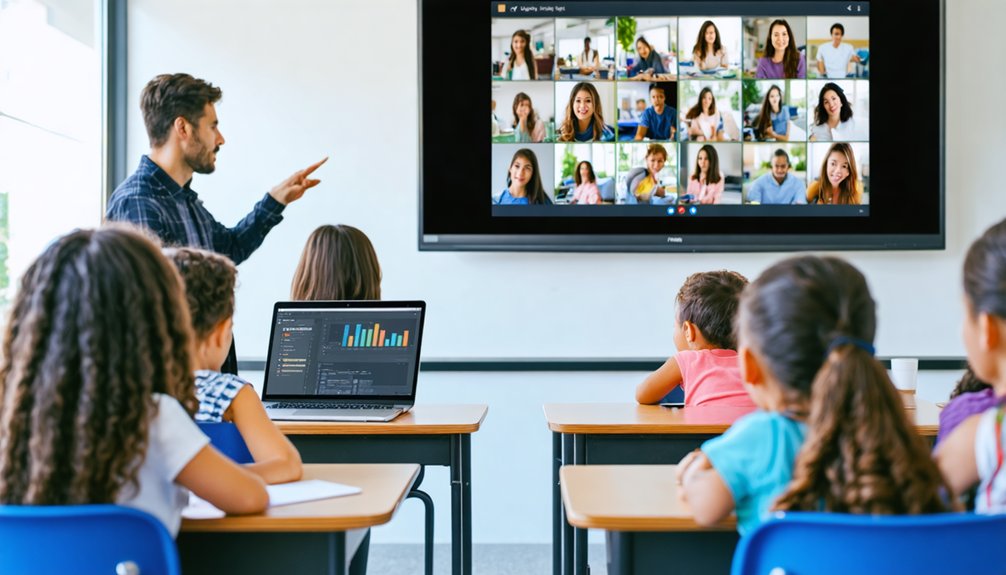

Hybrid education blends synchronous and asynchronous instruction to combine personalized pacing with in-person practice. Research shows large pre–post gains, higher retention, and improved engagement when digital tools and faculty readiness align. Designers use backward design, Bloom’s digital taxonomy, and UDL to maintain rigor and accessibility. Institutions standardize LMS, integrate collaborative whiteboards and assessments, and track participation and outcomes to close equity gaps. The model reshapes scheduling, pedagogy, scaling—and the sections below explain design, tools, metrics.
Why Hybrid Education Models Improve Outcomes?
Based on multiple empirical analyses, hybrid education models demonstrably improve student outcomes by combining flexible, personalized pacing with targeted digital tools and sustained face-to-face engagement. This aligns with research showing higher final grades in hybrid cohorts. Evidence shows a strong positive effect (path coefficient 0.550, p < 0.001) and large pre-to-post gains (d = 0.87), with final grades and cross-subject performance higher in hybrid cohorts using models like InterAcademy: Hybrid Future. Synchronous and asynchronous elements enable students to follow personalized pacing and proficiency pathways, accommodating work, family, and geographic constraints. Digital tools contribute additional, significant benefit (path coefficient 0.271, p < 0.001), enhancing assessment precision and instructional adaptation. When deliberately designed around learner needs, hybrid models yield equitable, superior academic outcomes and cultivate community among diverse student populations who seek belonging and mutual academic support. Research also indicates hybrid models significantly enhance student engagement. A quasi-experimental study in Kazakhstan found significantly higher performance.
How Hybrid Classrooms Boost Student Engagement?
Having established that hybrid models improve academic outcomes, researchers and educators now examine the mechanisms by which these configurations raise student engagement. This approach is valued for its flexibility and accessibility. Hybrid formats blend activity-based in-person sessions with purposeful virtual work, aligning group projects and small-class collaborations with asynchronous peer mentorship and livestream options for homesick or remote students. Students report increased motivation and convenience; teachers note higher engagement when content and modality align and when technology functions reliably. Research indicates that face-to-face learning often leads to superior learning outcomes compared with hybrid formats. Gamified assessments and social-media channels sustain attention and reward incremental progress, while autonomous learning windows build self-regulation. Remaining challenges—spotty access, lower material immersion, and uneven participation rates—are countered by targeted tools, scaffolded activities, and deliberate classroom design that cultivate inclusion, belonging, and consistent interaction across modalities. Success requires equitable resourcing and sustained professional development. Surveys show that 45% prefer on-campus.
Evidence: Academic Gains and Enrollment Trends
Multiple large-scale analyses and institutional studies indicate that hybrid education yields measurable academic and enrollment benefits: a strong path coefficient of 0.550 (p = 0.000) denotes a large positive relationship with academic performance, while meta-analyses and graduate-level course evaluations report equal or superior exam and course outcomes compared with traditional formats.
Institutional data show hybrid models increase retention and appeal: online and blended formats raise retention 25–60%, 82% of students prefer hybrid options, and 21% of colleges have adopted hybrid programs. These shifts correlate with rising longitudinal enrollment in flexible provisions and support credential stacking strategies that allow learners to layer microcredentials and certificates.
Overall evidence portrays hybrid education as empirically effective and institutionally revolutionary when supported by usable digital tools and faculty readiness. Research also shows a positive influence on student engagement, highlighting the role of flexible environments in that effect.
Designing a Hybrid Course That Preserves Rigor
Evidence of hybrid models’ academic and enrollment gains calls for a parallel emphasis on instructional design that preserves rigor as courses move to blended formats. A hybrid course commonly involves in-person and remote learners. Effective hybrid courses intentionally design before–during–after components so online and in-class activities complement each other.
Designers should apply backward design and Bloom’s digital taxonomy to define measurable outcomes, then map before-class, during-class and after-class activities to those outcomes.
Emphasis on pedagogy over platform guarantees equivalency across modalities, while Universal Design for Learning promotes equitable engagement and accessibility.
Assessments must align with course-level outcomes, maintain assessment integrity through clear protocols, and offer inclusive, time-efficient options.
Prior-semester reviews and student feedback inform cyclical improvements.
Institutions invest in faculty development so instructors can implement cohesive session objectives, manage workload norms, and create reusable learning artifacts that sustain high expectations and a welcoming learning community for diverse learners.
Tools and Workflows Teachers Need to Succeed
Equip teachers with an integrated suite of tools and streamlined workflows that align pedagogy, assessment, and classroom management across modalities.
Schools prioritize LMS consolidation—Canvas, Moodle, Hapara or School House Anywhere—to standardize learning workflows, automate scheduling, and reduce duplicated planning. Combined with virtual classroom platforms like Blackboard Collaborate and Zoom, instructors maintain synchronous engagement through auto-framing cameras, polls, chats, and digital whiteboards.
Content creation and assessment tools—Flipgrid, Wizer, Edpuzzle, Gimkit, Poll Everywhere—support multimedia instruction, formative checks, and gamified practice. Explain Everything and Vibe enable persistent collaborative whiteboards for review.
AI features and LMS integrations speed course assembly while analytics guide targeted instruction. Professional development emphasizes tech fluency, clear routines, and shared templates so teachers feel supported and connected and cultivate durable communities of practice together. Many platforms provide auto-grading and analytics to reduce teacher workload and inform targeted instruction.
Ensuring Equity and Accessibility in Hybrid Delivery
Equity in hybrid delivery hinges on deliberate design and institutional commitment to close gaps in connectivity, device access, and accessibility of materials so that students marginalized by race, class, disability, language, or location can participate fully. Institutions must pair pedagogical rigor with practical supports: affordable broadband, loaner devices, accommodations for disabilities, and culturally responsive course design.
Community partnerships amplify reach by supplying hotspots, devices, and localized training. Regular accessibility audits identify inaccessible resources and unequal course practices across online, hybrid, and HyFlex modalities.
Data-driven monitoring of participation and outcomes, combined with targeted advising and structured hybrid formats, narrows achievement gaps for underrepresented students. Policies should mandate beyond-basic ADA compliance, protect disclosure of disabilities, and fund sustained supports so belonging and measurable equity are realized.
Measuring Success and Scaling Hybrid Programs
Through a combination of quantitative participation metrics, learning-outcome indicators, and qualitative leader and teacher assessments, hybrid programs can generate a multidimensional portrait of effectiveness that supports purposeful scaling.
Administrators synthesize student participation metrics—attendance, interaction frequency, punctuality, platform usage, and active engagement—into outcome dashboards tied to NWEA MAP growth, credits earned, pass rates, and standards mastery.
Formative evaluations and practical skills assessments inform iterative instructional improvement while teacher training and high-quality practice sustain virtual relationships.
Leader perceptions and community partnerships shape priorities beyond test scores, emphasizing labor-market and civic results.
Scaling relies on flexible scheduling, context-adapted credit metrics, and professional development that aligns tools and assessment.
Continuous monitoring of satisfaction and soft-skill development guarantees equitable expansion and durable program impact with ongoing stakeholder feedback loops.
References
- https://rsisinternational.org/journals/ijrias/articles/the-future-of-learning-exploring-hybrid-educational-models-and-their-impact-on-student-engagement-and-performance-in-a-digitalized-world/
- https://www.encoura.org/resources/wake-up-call/hybrid-programs-which-students-want-them/
- https://www.gettingsmart.com/2026/01/26/how-virtual-and-hybrid-learning-helps-students-thrive-new-evidence-from-five-public-school-models/
- https://www.yellowbusaba.com/post/e-learning-online-learning-statistics
- https://elearningindustry.com/hybrid-education-features-that-make-it-the-future-of-learning
- https://eimpartnerships.com/articles/2026-higher-education-trends-how-universities-can-compete-in-a-quality-driven-market
- https://www.insidehighered.com/news/student-success/academic-life/2026/01/15/distance-education-enrollment-surges-nationwide
- https://ddooks.com/why-traditional-classroom-models-are-yielding-to-hybrid-solutions/
- https://tpmap.org/submission/index.php/tpm/article/download/552/554/1410
- https://eric.ed.gov/?id=EJ1102855