
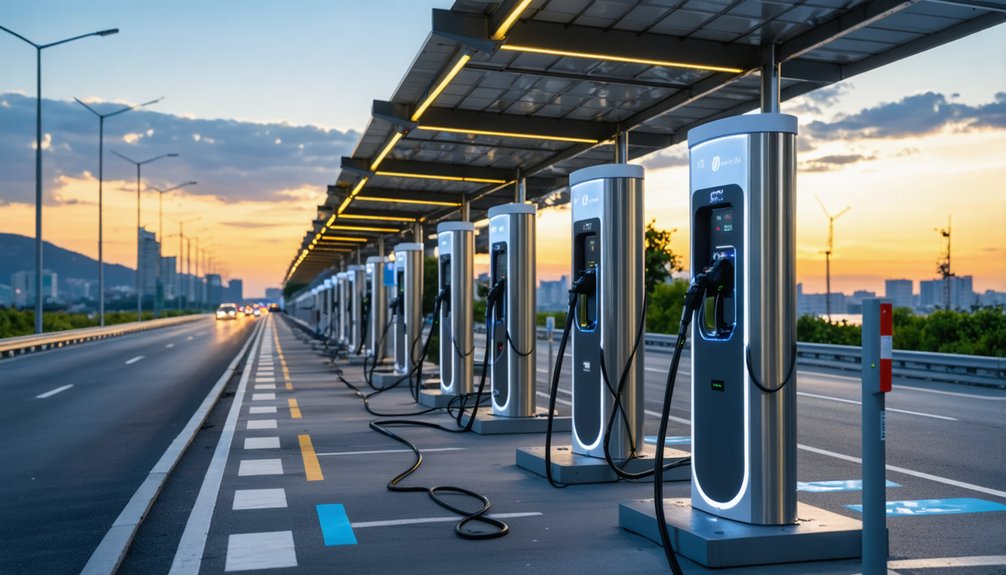

Federal funding and private investment are rapidly expanding smart charging nationwide. NEVI’s $7.5 billion and related grants accelerate 150+ kW DC fast deployments and require interoperability, open payments, and utility partnerships. Smart chargers provide cloud‑connected load management, predictive maintenance, variable pricing, and vehicle‑state optimization to reduce grid upgrades. Deployments concentrate at retail, multifamily, transit and highway sites with on‑site storage and renewables integration. The summary shows growth metrics and operational practices; detailed implementation guidance follows.
Why Smart Charging Stations Are Growing Nationwide
Amid rapid EV adoption, smart charging stations are scaling nationwide to match surging utilization—charging sessions rose 34% in 2025 while new ports grew just 16%, with over 1 million monthly ChargePoint users and nearly 60% of the 19.3 billion electric miles occurring in the past two years. ChargePoint enabled more than 100 million EV charging sessions in the last year.
Market forecasts project global charging-station revenues reaching 18.589 billion by 2026.
Observers attribute growth to technological innovations (ultra-fast chargers, AI scheduling, IoT monitoring), app-driven convenience, and resilient market expansion that values scalability and efficiency.
Networks reduce grid strain via adaptive pricing and V2G pilots, while energy management platforms enable greener charging and lower costs.
Successful deployment depends on consumer education to align expectations and behavior, and on coordinated urban planning to integrate stations into transit hubs, logistics clusters, and dense corridors, nurturing equitable access and community confidence now.
Industry analyses also note the market value reached USD 26.87 billion in 2025.
How Federal Funding and NEVI Rules Speed Deployment
Federal NEVI funding and updated deployment rules are accelerating public EV charger rollout by coupling $7.5 billion in federal support with streamlined regulations and clear technical standards. The program was created through the Bipartisan Infrastructure Law in 2021 and is a five-year program.
The program dedicates $5 billion via formula funding and $2.5 billion in competitive CFI grants, targeting 500,000 public chargers by 2030 and covering up to 80% of eligible project costs. The program provides up to 80% of eligible project funding, with recipients covering the remaining costs.
Requirements set minimums—DC fast charging at 150 kW for four vehicles, non‑proprietary hardware, open payments—and mandate Build America Buy America compliance.
Regulatory flexibility allows sites beyond designated corridors once built out, encourages site‑host ownership, and simplifies state deployment plans reviewed annually.
Combined with Federal incentives like the 30C tax credit and reserved grants for disadvantaged areas, NEVI accelerates scalable, equitable charger deployment nationwide and strengthens community access.
As of October 2025, there are 121 stations energized across 16 states.
What “Smart” Chargers Actually Do and Why It Matters?
NEVI’s funding and technical rules accelerate charger deployment, but the value proposition for operators, utilities, and drivers increasingly rests on smart charging capabilities that monitor, manage, and modulate energy use in real time. Many residential smart chargers support up to 11.5 kW of AC charging, enabling faster overnight fills.
Smart chargers monitor station load, vehicle state of charge, and grid signals via cloud platforms, enabling energy optimization through load shifting, peak shaving, and adaptive load balancing across sites. Integrated Wi‑Fi, PowerSmart load balancing, and backend analytics provide firmware updates, remote diagnostics, and pricing-aware scheduling. This coordination is enabled by dynamic load management.
For operators and utilities this reduces infrastructure upgrades and operational costs; for drivers it improves user experience with apps, notifications, contactless payments, and prioritized sessions. Overall, smart charging delivers cost savings and greater convenience for users and operators.
The result is higher uptime, better renewable integration, and measurable cost savings for the charging community, and improved equity across communities.
Where New Stations Are Appearing and Who’s Hosting Them
Across the country, public charging capacity is expanding in concentrated city and commercial settings where demand is highest: Maryland’s EV Smart network already exceeds 850 Level 2 and DC fast chargers across BGE, Pepco, and Delmarva service areas and is mapped in real time by ChargeHub, while Texas cities such as Dallas (480+ ports) and Austin see rapid rollouts by Smart Charge America and El Paso Electric, and Washington, D.C. plans 7,500 public stations by 2027 as renter and condo charging rights are strengthened.
Users can find paid and free stations with real-time availability on the ChargeHub map.
Growth clusters at supermarkets, retail plazas, hotels and multifamily developments meet routines; transit hubs and transitriage points connect trips. Nationwide counts show nearly 68,000 DC fast ports across 14,623 locations, up 17.8% year over year, guiding partnerships and site prioritization.
How Operators Use Load Balancing, Storage, and Renewables
As public charging footprints concentrate in commercial, multifamily, and transit-oriented locations, operators rely on integrated load balancing, on-site storage, and renewable coordination to expand capacity without costly electrical upgrades.
Operators implement continuous real-time monitoring and intelligent distribution to prevent overloads, allocating precise 1 kW increments so facilities serve varied needs (for example, 4 EVs at 20 kW and 3 at 5 kW in a 100 kW site).
On-site storage and battery aggregation enable up to four chargers on a single circuit, simulate virtual grid expansion, and adaptively reroute power as vehicles connect.
Renewable coordination uses grid forecasting and tariff signals to schedule sessions, shave peaks, and balance intermittent inputs.
These combined strategies reduce infrastructure upgrades, cut demand charges, and increase equitable access for communities.
What Drivers Can Expect at Modern Smart Charging Sites?
How quickly will a stop replenish range? Drivers encounter DC fast charging (over 150 kW) reaching 80% in under 30 minutes, and high‑speed DCFC providing 60–80 miles in 20–30 minutes for long trips.
Level 2 (240 V) adds about 60 miles per hour for 4+ hour dwell times; Level 1 remains suitable only for overnight charging.
Stations pair intuitive smartphone apps, Plug and Charge and Wi‑Fi for locating, starting and billing sessions, plus remote scheduling and energy tracking.
Clean restroom amenities, food, coffee and convenience retail support 20–30 minute breaks.
Built‑in safety systems and predictive maintenance (AI monitoring, >99% uptime) keep chargers reliable.
The experience emphasizes accessibility, clarity and community for EV drivers.
Real‑time status updates and intuitive dashboards simplify planning and cultivate a shared confidence.
Key Trends and Near-Term Challenges for Scaling Smart Charging
Against mounting grid constraints and sharply rising market growth, scaling smart charging will require coordinated advances in energy management, capital models, and technical interoperability. Stakeholders must deploy AI-driven DELMS, integrate microgrids, solar, and battery storage, and use V2G aggregation to smooth peaks while maintaining uptime. Dynamic pricing, predictive maintenance, and modular designs reduce operational risk and support fleet needs.
However, Investment costs remain a near-term barrier: high CapEx, rip-and-replace expenses, and nonstandard hardware slow rollouts. Charging-as-a-Service and public–private partnerships can lower obstacles and accelerate deployment. Standardized protocols and partnerships with utilities and automakers are essential to resolve interoperability and grid constraints.
Clear metrics, shared platforms, and inclusive governance will help communities scale equitably. Transparent funding models and training programs build trust and capacity.
References
- https://www.nextmsc.com/blogs/how-is-the-electric-vehicle-charging-infrastructure-market-evolving-in-2026
- https://qmerit.com/blog/nevi-program-charging-incentive-updates/
- https://www.telemetryagency.com/post/january-22-2026-ev-charging-still-expanding-in-us
- https://driivz.com/blog/2026-key-ev-tech-launches-cpos-should-watch-now/
- https://www.smartcitiesdive.com/news/ev-charger-funding-court-ruling/810685/
- https://www.batterytechonline.com/charging/a-bright-moment-for-america-s-ev-charging-expansion
- https://www.morningstar.com/news/accesswire/1138453msn/global-ev-charging-station-market-to-surpass-usd-143-billion-by-2035-as-ultra-fast-charging-smart-infrastructure-and-renewable-integration-accelerate-electrification
- https://www.chargepoint.com/about/news/chargepoint-network-data-demonstrates-charging-demand-continues-outpace-growth-charging
- https://www.researchdive.com/83/ev-charging-infrastructure-market
- https://digitalpower.huawei.com/en/news/smart-charging-network/top-10-trends-charging-network-industry