

Buyers should confirm battery state‑of‑health, warranty transferability, and recent diagnostic data showing cell voltages, internal resistance and BMS faults. Match realistic degraded range to daily needs and test on varied roads and temperatures. Verify charging inlet type, included cords/adapters, and home/work charging plans. Review service history, MOT/recalls, and title documents for prior damage. Compare CPO/dealer protection versus private‑sale risk. Further sections explain inspections, costs, and negotiation tips and get a certified inspection before final purchase.
Is a Used Electric Vehicle Right for You?
How should a prospective buyer decide if a used electric vehicle (EV) suits their needs? Modern EVs typically retain 80–90% of capacity after 8–10 years. A pragmatic appraisal emphasizes battery health, long-term reliability, and repair exposure. UK testing of over 8,000 batteries found average battery health near 95%. Recent UK testing shows average battery health near 95%, with many eight- to nine-year vehicles retaining ~85% capacity, and high-mileage examples still at 88–95%. Prospective owners assessing commute fit and lifestyle compatibility should consider model-specific records: Mini Electric, Nissan Leaf and Volkswagen e‑Up rank highly for reliability, while Tesla and Hyundai offer strong warranties. Expect fewer moving parts and lower lifetime maintenance, but a higher incidence of minor electrical issues versus petrol cars. This is largely because EV drivetrains have fewer moving parts, which reduces traditional mechanical failure modes while introducing electrical and software issues. Transparent battery condition and warranty coverage create community confidence; informed shoppers align choices with documented retention and typical repair costs. and realistic ownership expectations exist.
Set Range and Daily Charging Needs
Having weighed reliability and battery health, prospective buyers should establish realistic range and daily charging needs before committing to a purchase. Independent testing uses a 60/40 city/highway mix, which can influence real-world range comparisons. Buyers are advised to match expected real-world range—typically 50–250 miles for pre-owned models—to habitual patterns: an 80-mile range can suffice for many first-time drivers, while those needing 190–200 miles may accept older 250-mile-rated models now reduced by degradation. Test drives across varied terrain validate estimates and reveal seasonal impacts such as cold-weather losses. As of early 2025, many late-model used EVs were trading around mid-$20Ks. Also check the battery SOH.
Confirm EPA estimates against manufacturer data and align purchase choice with daily commute distances to avoid overpaying. Assess home and workplace charging access and set a practical charging schedule that fits lifestyle and available infrastructure, noting differences between Level 2 and DC fast charging for long-term value and owner confidence.
Check Used Electric Vehicle Battery Health and Warranty
Evaluating battery health and warranty status is essential: buyers should verify State of Health (SOH)—with >85% considered good, 70–85% acceptable, and <70% signaling significant degradation—obtain a fast, manufacturer-compliant diagnostic (for example an Autel SOH Blitz report or dealer scan showing cell voltages, internal resistance, and BMS faults), and confirm the remaining battery warranty and its transferability before proceeding. On average, battery capacity declines at about 1–2% per year, a normal long-term rate to keep in mind. Technicians note that degradation typically accelerates after 150,000 miles.
A structured checklist recommends requesting an Autel SOH Blitz or equivalent OBD/dealer scan, reviewing cell voltage balance, internal resistance, and temperature data, and performing a controlled range comparison test. Many buyers are turning to the used market because of economical pricing.
Professionals use manufacturer tools to validate results.
Confirm warranty transfer rules and any remaining term; prefer certified pre-owned vehicles with active battery coverage.
Clear battery diagnostics and transferable warranty materially reduce ownership risk.
Ask about charge habits.
Review Vehicle History, Recalls, and Past Maintenance
In evaluating a used electric vehicle, prospective buyers should prioritize a systematic review of vehicle history reports, service and maintenance records, recall completion documentation, MOT/inspection histories, and ownership/title papers; together, these documents reveal past accidents and structural or battery-related damage, verify mileage and odometer integrity, confirm completion of critical software and service updates, and disclose open recalls, liens, or title problems that materially affect safety, warranty transferability, and future resale value.
A thorough assessment combines vehicle history data with service records to identify service gaps, recurring failures, and evidence of proper battery care. Recall documentation and MOT histories verify completed repairs and safety compliance. Title checks confirm legal transferability and lien absence. Decisions should be grounded in documented facts and transparent seller disclosure always. Additionally, request a battery state of health (SoH) report and confirm any battery warranty coverage and transferability.
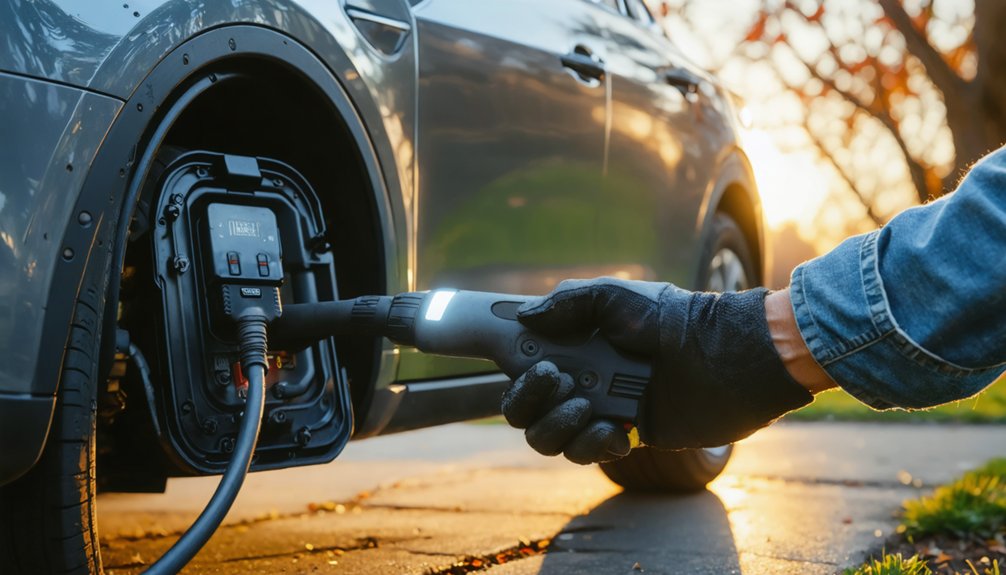
Confirm Used Electric Vehicle Charging Access and Included Accessories
Before purchase, buyers should verify what charging equipment and adapters accompany the vehicle and whether the car’s connector standards match the most relevant public and home chargers in their area.
The used-EV inspection should confirm included cords for Level 1 mobile charging and any Level 2 J1772 cable; most North American non‑Tesla models use J1772 for home/public AC charging.
Confirm adapter compatibility: Tesla vehicles require a J1772‑to‑Tesla adapter for non‑Tesla stations, while non‑Tesla cars may need a Tesla‑to‑J1772 adapter to use Tesla Destination chargers.
Check DC fast-charge inlet type (CHAdeMO, CCS1, NACS) because fast chargers lack universality.
Verify no proprietary accessories are missing and avoid extension cords; make certain homeowners plan for proper Level 2 installation if needed and reconcile adapter costs with local availability.
Estimate Total Cost of Ownership and Available Incentives
A thorough total cost of ownership (TCO) assessment quantifies purchase price, taxes, financing, insurance, depreciation, routine maintenance, fuel or charging costs, and expected repairs over a defined ownership period—commonly five years—while explicitly subtracting applicable incentives such as federal used‑EV tax credits.
Practitioners recommend modeling five‑year scenarios using reliable calculators (DOE eGallon, Edmunds TCO) and local utility rates to capture per‑mile savings—about $0.092 on average versus gasoline—and lower maintenance costs.
Depreciation often dominates five‑year expenses and should feed resale forecasting.
Buyers should inventory transferable warranties, state rebates, and potential incentive stacking to reduce net cost. Fleet assessments may also include downtime impacts.
Clear, evidence‑based TCO comparisons help prospective owners and community members choose vehicles aligning with their budget and values and long‑term sustainability goals today.
Pick CPO, Dealer, or Private Sale for Used Electric Vehicle
The choice between Certified Pre‑Owned programs, dealer inventory, and private sales hinges on balancing upfront cost, warranty protection, and risk exposure.
A CPO vehicle offers manufacturer-backed extended warranty coverage, 24/7 roadside assistance, and factory-trained technician inspections that reduce buyer risk; higher price is offset by lower long-term repair probability.
Dealer purchases provide vehicle-history reports, professional diagnostics for battery state-of-health, and verified recall remediation, supporting transparent warranty negotiation and easy inspection scheduling through service desks.
Private sales deliver lower upfront cost but require independent SoH testing and careful document vetting; they lack manufacturer backing and limit recourse.
Buyers seeking community reassurance should weigh total cost of ownership, confirm remaining warranty transferability, and prioritize documented battery health to align with shared expectations for reliability and support.
References
- https://www.kbb.com/car-advice/buying-used-electric-car/
- https://cargiantwa.au/blogs/the-ultimate-guide-to-buying-a-used-ev-in-2026/
- https://www.caranddriver.com/shopping-advice/a69980017/used-electric-car-ev-shoppers-buyers-guide-2026/
- https://www.sandicliffe.co.uk/blog/buying-a-used-electric-car-battery-health-best-models-2026
- https://www.overstockvehicles.com/blog/buying-a-used-ev-what-to-look-for-what-to-avoid/
- https://www.edmunds.com/electric-car/
- https://www.canadadrives.ca/blog/car-guide/what-to-look-for-when-buying-a-used-electric-car
- https://www.recurrentauto.com/research/used-electric-vehicle-buying-report
- https://www.electrifying.com/blog/best-cars/best-value-used-electric-cars-for-2026
- https://transportandenergy.com/2026/02/19/used-ev-battery-performance-report-highlights-degradation-not-a-systemic-risk/