
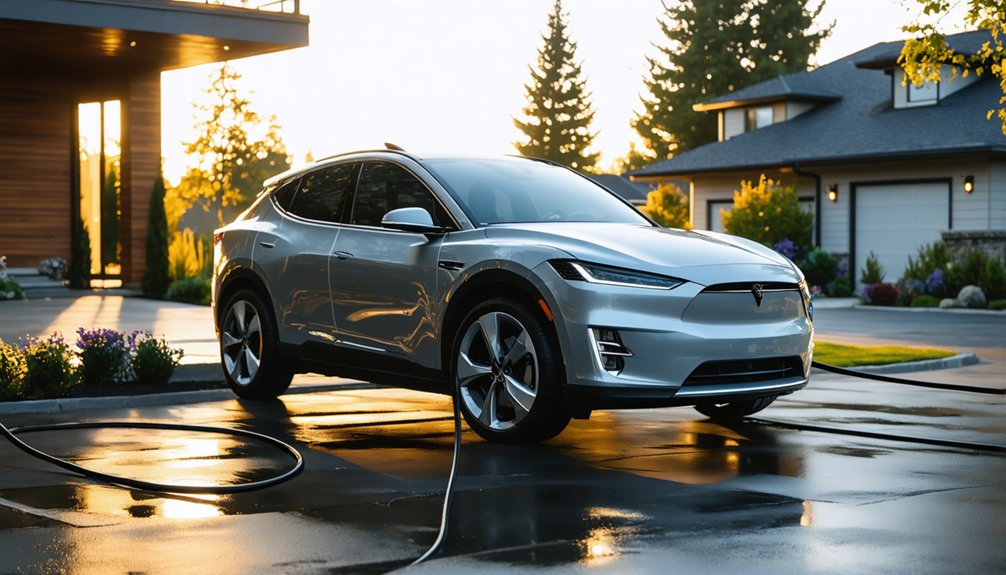

Electric crossovers appeal to families because they blend long real-world range, low operating costs, and flexible interiors. Many 2026 models exceed 300 EPA miles and fast-charge rapidly. Home chargers cut daily costs and simplify routines. Cargo volumes and three-row layouts match kid and gear needs. Advanced ADAS and strong crash ratings improve safety. Total cost of ownership often undercuts ICE rivals. Further sections explain model tradeoffs, charging strategies, and selection criteria for family buyers worldwide.
Why Electric Crossovers Fit Modern Family Life
For modern families balancing cost, comfort and community impact, electric crossovers deliver measurable benefits: households replacing gasoline crossovers report annual fuel savings around $1,100 (Las Cruces, Phoenix suburbs) and examples include $1,500 saved by a Provo family switching a pickup and $750 saved in Thornton after 9,000 miles, while studies show an average household could save roughly $1,400 per year when all vehicles are electrified, including about $600 from reduced maintenance and fuel. By replacing gasoline crossovers, families also reduce harmful neighborhood pollution from Road-vehicle emissions. Analysts note that operating efficiency and lower fueling and upkeep costs translate into predictable household budget relief.
Interiors utilize flat-floor layouts for increased legroom and cabin comfort, appealing to family needs.
Home charging integrates with routines, reducing errands and reinforcing shared community benefits through cleaner air and resilience and social cohesion. Charging at home also means families can rely on overnight charging to avoid frequent trips to gas stations.
Importantly, EVs are about four times more energy efficient than petroleum vehicles.
What Range and Charging Look Like for Families?
Consumers evaluating electric crossovers can expect a combination of long single-charge ranges and rapidly improving fast‑charging that supports daily family routines and weekend travel. Affordable options like the 2026 Hyundai Ioniq 5 deliver competitive range, with 221–318 miles EPA-rated figures. Several top models offer extreme range—for example, the Lucid Gravity can reach up to 450 miles on a single charge. Data show many 2026 crossovers exceed 300 miles—Hyundai Ioniq 9 (311–335), Polestar 3 (~350), Kia EV9 (230–305), Chevrolet Equinox EV (288–319); luxury options like Cadillac Escalade IQ and Lucid Gravity project ~450–460 miles.
Fast charging access varies: Mercedes GLB EV adds 161 miles in 10 minutes, Polestar 3 supports 150 kW, and Kia EV9 gains NACS Supercharger compatibility. Also, the Chevrolet Silverado EV offers up to 460 miles of range, underscoring how manufacturers are pushing single-charge distances higher.
Families benefit from trip routing tools integrated into vehicles and apps for realistic planning.
Long range planning should factor in Battery degradation concerns, charging availability, and three‑row needs to guarantee predictable commutes and confident longer trips.
Communities gain reassurance from measurable performance data.
How Cargo and Seating Layouts Beat Competitors
Compared with many gas SUVs, electric crossovers deliver measurable cargo and seating advantages: the Cadillac Escalade IQ leads with 125.2 cubic feet (followed by a 119.1‑cu‑ft variant and Lucid Gravity at 111.9 cu ft), while family‑oriented designs balance passenger capacity and usable load—Kia EV9 offers 84.9 cu ft and a seven‑seat layout with 828 liters of boot space, Hyundai IONIQ 9 accommodates seven with 338 liters all rows up yet expands to 2,419 liters with the second and third rows folded, and Tesla Model Y moves from 854 liters seats up to 2,158 liters folded plus a 117‑liter frunk; Mercedes EQB reaches 1,710 liters with rear seats down. Models such as the Tesla Model Y also highlight value with competitive starting prices and long EPA‑estimated ranges. This trend is supported by iSeeCars analysis of more than 12 million vehicles showing notable value and longevity differences across EV crossovers. Additionally, many popular crossovers include a small front trunk for extra secure storage, commonly called a frunk.
Safety and Technology Family Buyers Care About
Alongside flexible interiors, family buyers also weigh how electric crossovers perform in crash tests and real‑world safety metrics.
Recent NHTSA five‑star results and multiple IIHS Top Safety Pick+ awards for 2026 models like the Ioniq 5, EV9, Mustang Mach‑E and Model Y give objective baselines.
Advanced pedestrian detection and automatic emergency braking—notably radar+camera fusion in the EV9—improve nighttime stopping where single‑sensor systems lag.
Manufacturer and fleet data (Kia: zero fatalities in 50,000 EV9s; Tesla: one crash per 4.31M miles with Autopilot engaged) complement standardized test scores to show real‑world performance.
Structural platforms such as E‑GMP and strong roof ratings support rollover resistance and occupant protection.
Buyers seeking community reassurance favor models with documented, redundant safety systems and transparent testing outcomes and clear reporting practices. Industry data indicate that EVs are as safe as conventional vehicles in both tests and real‑world metrics.
Real-World Costs: Purchase, Running, and Resale
Several measurable factors determine the real-world cost of family electric crossovers: upfront price, per-mile energy efficiency, charging speed, and projected resale value. Buyers comparing Total cost see models from Nissan Leaf ($26,000–$31,485) and Hyundai Kona Electric ($34,470) to Chevrolet Equinox EV ($36,795), Toyota bZ ($36,350) and Ford Mustang Mach-E ($39,840).
Per-mile efficiency ranges widely: Leaf 103–121 mpg-e, Equinox EV 96–108 mpg-e, Lucid Gravity 90–108 mpg-e; range affects running costs, with Ioniq 5, Mach-E, Genesis and Polestar offering 221–350 EPA miles.
Faster charging and larger batteries (Volvo EX40, Genesis GV70) reduce downtime and operating expense. Entry-level pricing and recent Mach-E cuts support stronger resale; evaluating Depreciation risk remains central to long-term ownership decisions for community-minded family buyers. They can also factor incentives and charging access.
Top Electric Crossover Choices by Family Need
For family buyers prioritizing specific needs, the market breaks into clear segments—three-row practicality (Kia EV9, Hyundai Ioniq 9, Lucid Gravity, Volvo EX90), cargo flexibility (Kia EV9, Lucid Gravity, Tesla Model X, Hyundai Ioniq 5), long-range road-trip options (Lucid Gravity 386–450 EPA miles, Kia EV6 231–319, Kia EV9 230–305, Cadillac Lyriq >300 tested), luxury and comfort (Genesis GV70, Cadillac Optiq, Volvo EX40, Mercedes GLC), and performance/tech-focused choices (Kia EV6, Mustang Mach-E, BMW i3 Noi Classa, Audi Q6 Ron, Tesla Model Y).
Buyers balancing Morning Commutes and weekend road trips can match EPA range and charging to routines. Three-row models deliver space and safety; cargo-focused choices highlight Pet Friendly Features and flexible layouts. Luxury trims prioritize quiet comfort; tech models offer rapid charging and spirited driving.
How to Choose the Right Electric Crossover for You
When choosing an electric crossover, buyers should prioritize measurable needs—passenger and cargo capacity, primary charging access, realistic range, budget, and driving preferences—then match models to those criteria.
A data-driven checklist compares compact options (Kia EV6, Ford Mustang Mach‑E) for smaller families versus three‑row models (Kia EV9, Cadillac Lyriq) for more cabin and cargo.
Charging strategy matters: home versus public, NACS access to Tesla rapid chargers, or CCS with adapters; Chevrolet Equinox EV fast‑charges in 1.09 hours and Kia EV9 Light Long Range RWD in 1.28 hours.
For range, plan on 60–70% of EPA at highway speeds; Equinox EPA 319, Model Y 277, Lyriq exceeds 300 tested miles.
Consumers should weigh budget tradeoffs and climate priorities against features, total cost, and real-world performance and ownership experience.
References
- https://tridenstechnology.com/electric-car-sales-statistics/
- https://www.rac.co.uk/drive/electric-cars/choosing/electric-car-statistics-and-data/
- https://caredge.com/guides/electric-vehicle-market-share-and-sales
- https://ev-volumes.com
- https://www.youtube.com/watch?v=1tb6AVNlxP4
- https://www.autoblog.com/news/study-shows-massive-shift-in-ev-sentiment-may-affect-2026-sales-in-a-big-way
- https://afdc.energy.gov/data/10567
- https://www.swenergy.org/electric-vehicles-save-families-money/
- https://www.honestlymodern.com/electric-cars-for-families/
- https://www.cleanegroup.org/electric-vehicles-in-the-community-benefits-and-challenges/